Breathing practices develop awareness of breath and body.
Yoga breathing
The cycle of yoga breathing has three parts, each of which should be learned separately before they are joined together. Ideally, the student should practise daily until the transitions between the three parts can be made smoothly and effortlessly.
Breathing should be done through the nose, providing it is not congested. When practising, relax the jaws, tongue and throat. Closing or half-closing the eyes gives a stronger inward focus. Yoga breathing should be done without strain, and while lying down, sitting or standing. To begin with, it is advisable to lie on the back. Placing the hands on the abdomen or ribs is helpful initially; it will make the novice become aware of how to move with ease through the three parts.
At the outset, a sequence of yoga postures should start with seven cycles of full yoga breathing. During this time, all the blood in the body is likely to have passed at least once through the lungs. In addition, yoga breathing should be done 2-3 times after the short rest between the postures in any yoga sequence.
Part 1: Abdominal breathing
Lie on the back. Initially, place the palms on each side of the abdomen close to the navel in order to register the breathing movements.
Breathe calmly and regularly so that the abdomen expands. The chest should not participate in inhalation in part 1.
When breathing out, release the breath naturally and effortlessly.
Rest for a few seconds before starting the next breath.
Repeat 5-10 times.
The movements of the abdomen are caused by contractions in the ring-shaped muscles of the two domes of the diaphragm. With these movements, the organs in the abdomen are pushed gently down and out while the lungs are filled with air.
Part 2: Costal breathing
Lie on the back. Initially, place one palm on each set of ribs in order to register their movements when breathing. Breathe in calmly and regularly so that the chest expands. Make sure that the breathing only involves the ribs. This can be checked by pushing the hands firmly against the ribs.
When breathing out, release the breath naturally and effortlessly.
Rest for a few seconds before starting the next breath.
Repeat 5-10 times.
Part 3: High costal breathing
Lie on the back. Initially, place the palms on the upper chest to register the breathing movements. Breathe in calmly and regularly so that the upper part of the chest expands a little and subsequently the shoulders are lifted.
When breathing out, release the breath naturally and effortlessly.
Rest for a few seconds before starting the next breath.
Repeat 5-10 times.
Yoga breathing
Full yoga breathing
In full yoga breathing, the three parts of yoga breathing (pages 122-123) are combined into one continuous, gliding movement. Each part should flow smoothly into the next, starting in the abdomen and travelling upwards via the ribs to the shoulders. The lungs will then be filled with air.
Lie on the back with the arms along the sides.
Start breathing in so that the abdomen expands (abdominal breathing, page 122).
Continue breathing in so that the chest expands (costal breathing, page 123).
From the ribs, continue upwards, breathing in slowly through the upper body, involving the shoulders and collar bones (high costal breathing, page 123).
Rest for a brief moment with full lungs before relaxing and exhaling passively, letting the breath flow out calmly and continuously.
Repeat 7 times.
Rest while lying on the back.
When learning full yoga breathing, follow the movements of the breath upwards through the body by placing the hands first on the abdomen, then on the ribs and finally on the upper part of the chest. Once the breathing can be performed with ease, it may be done in a sitting position, for example with the legs crossed, on the heels or in the half lotus pose.
Full yoga breathing
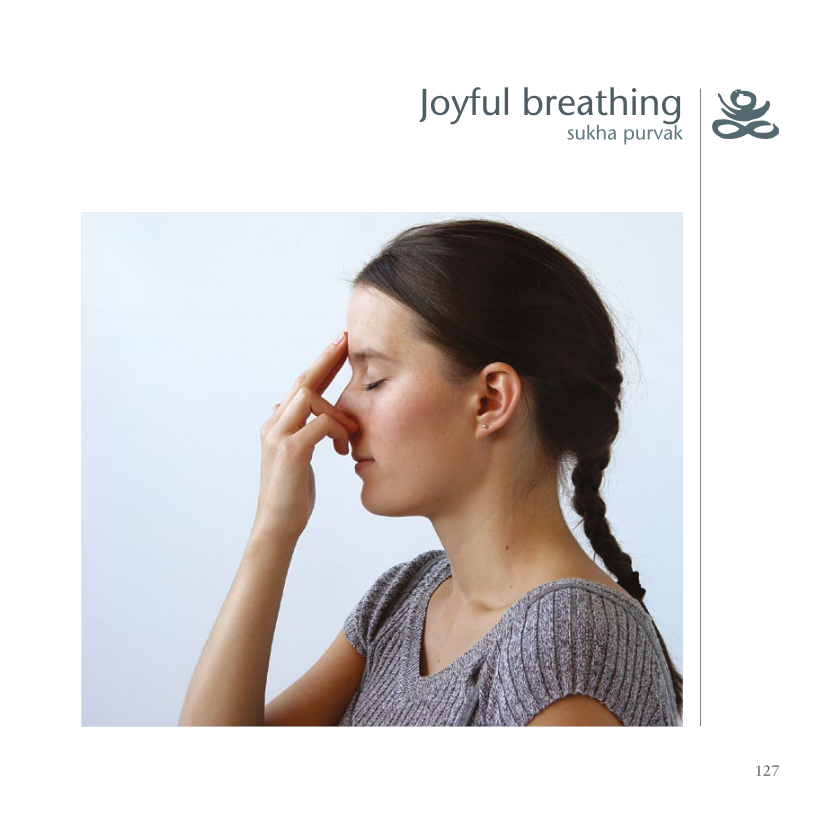
Joyful breathing sukha purvak
Joyful breathing (I)
Sit cross-legged, on the heels or in the half lotus.
Apply light pressure to the outside of the right nostril using the right thumb.
Calmly breathe out through the left nostril, and then in again.
Transfer the pressure to the left nostril using the middle and ring fingers, removing the thumb from the nose.
Calmly breathe out and then in again through the right nostril.
Breathe effortlessly through alternate nostrils for a few minutes.
Joyful breathing (II)
Sit cross-legged, on the heels or in the half lotus.
Left nostril
Apply light pressure to the outside of the right nostril using the right thumb. Place the index finger on the forehead a little above the eyebrows in the midline between the eyes.
Breathe out calmly through the left nostril, counting 8 heartbeats.
Hold the breath, counting 1 heartbeat.
Breathe in through the same nostril, counting 4 heartbeats.
Hold the breath with full lungs, counting 16 heartbeats.
Right nostril
Now shift the pressure to the left nostril using the long and ring fingers, removing the thumb from the nose.
Breathe out calmly through the right nostril, counting 8 heartbeats.
Hold the breath, counting 1 heartbeat.
Breathe in through the same nostril, counting 4 heartbeats.
Hold the breath with full lungs, counting 16 heartbeats.
Continue as in point 3 above and repeat the pattern by alternating between the nostrils.
To begin with, do 3 repetitions on each side, gradually increasing to 8 on each side.
The heartbeats can be counted by holding the left hand around the right wrist. To begin with, counting heartbeats is less important than achieving a calm, relaxed flow between the various parts of the practice, i.e., breathe out – hold – breathe in – hold – change nostril. The breathing should be neither too deep nor too superficial, and there should be no need to take in extra air through the mouth.
Joyful breathing sukha purvak
Pump breathing
Lie on the back with the arms along the sides.
Fill the lungs by using the full yoga breathing.
While breathing out, bend the left leg and raise it over the chest, simultaneously lifting the head towards the knee. Link the hands around the shin and pull the leg close to the forehead. Keep the right leg slightly off the ground and push the heel away from the body with the foot flexed so that the toes point towards the body.
While breathing in, calmly lay the head, legs and arms down again.
When breathing out next time, bend up the right leg and repeat the movements.
Repeat 5-7 times with each leg.
Rest while lying on the back.
Breathe deeply and regularly during this practice. In the beginning, the practice may be repeated 5 times with each leg, alternating between them. With practice it should become possible to change legs in the air without letting them rest on the ground in between. The number of repetitions may also be increased as the abdominal muscles get stronger.
Sit on the heels with the hands in the lap.
Bend forwards and place the palms on the ground. Kneel on all fours.
While breathing out, curve the back upwards and pull the chin towards the hollow of the throat. Stick the tongue out and extend it towards the chin.
While breathing in, curve the spine downwards so that the head and the bottom are raised. Roll the tongue backwards in the mouth.
Repeat 5-10 times with calm and regular movements that follow the breathing.
Sit down in the starting pose and rest.
Cat breathing
Standing breathing
Stand with the arms at the sides and the legs apart.
While breathing in, lift the arms forwards, up and out.
While still breathing in, stretch the arms backwards slightly so that the chest is lifted and the lungs can be completely filled with air. Do not bend the spine too far back. Breathe out by letting the arms and upper body fall towards the knees. Repeat 5-7 times.
Standing breathing
Cooling breath
sitali pranayama Sit cross-legged.
Place the right index finger over the right nostril.
Roll the tongue to form a tube that protrudes slightly from the mouth, or place the tongue at the base of the front teeth and pout the lips.
Breathe in through the mouth so that the air flows along the tongue.
Breathe out through the left nostril.
The ability to shape the tongue like a tube is hereditary, not a question of training. Those who cannot do it can use the alternative method of pressing the tongue against the lower front teeth, pouting the lips and breathing in by directing the air along the tongue.
This breathing practice is said to have a cooling effect on the body. It may be continued for up to 5 minutes.
Spontaneous inhalation
Lie on the back or stand with the legs slightly apart.
Breathe slowly and forcefully out through the nose, emptying the lungs.
Let the breath flow in by itself.
Exhale forcefully a second time.
Again, let the air flow back into the lungs of its own accord.
Repeat this pattern until the body spontaneously responds by drawing a long, deep breath.
Then rest.