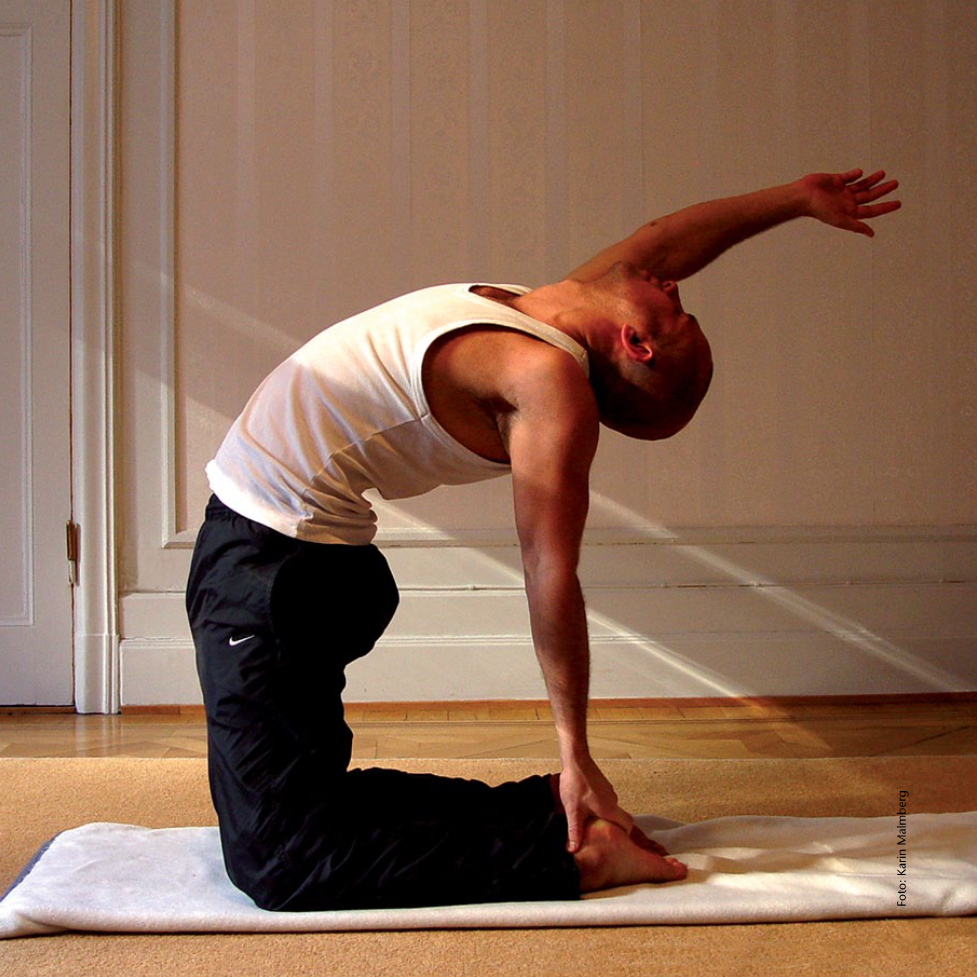
Meditative yoga integrates body, breath and mind.
Over the past hundred years, people’s recreational needs have been turned upside down. Formerly, most people’s work took the form of physical labour, and they became physically tired and rested in their free time.
Nowadays, most of us hold jobs that involve very little physical activity, so we tend to exercise in our spare time. At work, we generally use our brains – our knowledge, social and intellectual skills – to meet the demands of a competitive environment. This means that mental stress is a more prevalent feature of our lives today, and in order to decompress many resort to the unhealthy habit of taking a glass of wine or beer after work. However, there is a growing interest in alternatives, including self-administered techniques like meditation and yoga.
Stress reduction - begin tired, end fit
There is no single medical definition of stress. But we know that in moderate amounts, stress stimulates the organism and is healthy. Prolonged and relentless stress, however, may reduce the mental capacity and be detrimental to physical health. The ideal would be a good balance between stress and relaxation in our lives.
Classical yoga may be of great help in reducing stress and in finding this balance. It comprises physical postures, breathing practices and attention training, also known as meditation. In classical yoga the postures are carried out slowly. Even so, they have significant effects on the inner organs, and on the muscles, joints, tendons and circulation. A person may start a yoga session feeling tired, and end by feeling fit and full of energy. Doing yoga doesn’t drain one’s energy, but adds to it. Moreover, it produces relaxation, enhances physical well-being and creates a new starting point from which to take on the many challenges in life.
Classical yoga postures make the student freer and more attentive to the body’s signals and those in the environment. Practising yoga requires a minimum of space and can be done at any suitable time. It does not presuppose a specific belief or lifestyle, and this independence from ideology and culture has promoted the spread of yoga to all corners of the globe in recent decades.
Side notes
Silence has many faces. It may be like the tender love between father, mother and child. It links us to dimensions of existence that are untouched in the clatter of daily life, and bring us peace, contentment and clarity.
Silence may also be frightening, confronting, a reminder of unresolved issues and of a life not lived.