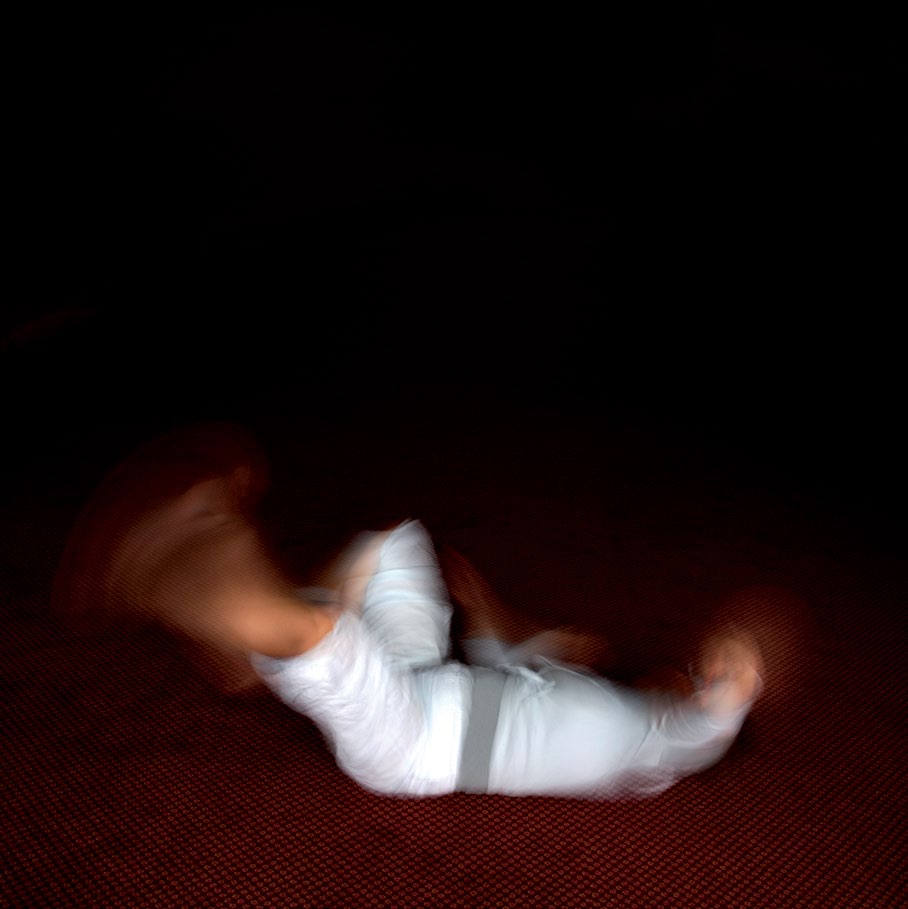
Impulse practices use slow or rapid movement impulses.
Impulsive slow twist (I)
Lie on the back with the arms along the sides.
Let the attention travel to the face. Become aware of the subtle sensations, impulses, tiredness and tensions that may be there.
Let those sensations or impulses be expressed in slow movements or grimaces. Allow the facial muscles to twitch, contract and stretch freely.
Gradually involve the fingers, toes, hands, arms and feet as extensions of the facial movements.
Continue extending the movements to more body parts until the entire body is involved. Breathe freely.
Continue for 1-3 minutes.
Lie on the back to rest.
Impulsive slow twist (II)
Lie on the back with the arms along the sides.
Let the attention travel to the abdomen. Become aware of the sensations, impulses or tensions that may be there.
Release these sensations or impulses from the abdomen and give them expression in slow movements out towards the rest of the body.
Gradually involve the chest and hips, arms and legs.
Eventually, let the entire body participate. Breathe freely.
Continue for 1-3 minutes.
Lie on the back to rest.
Rapid shaking
Lie on the back with the arms along the sides.
Lift the arms and legs.
Let the attention rest on your feelings at this moment. Notice emotions, moods and frustrations.
Release these feelings to be expressed as shaking movements of the arms and legs.
Gradually increase the speed and intensity until the arms and legs are shaking as fast as possible. Finally, allow the breathing to be impulsive too; breathe fast and intensively. Let the whole body participate in these rapid movements.
Continue for 1-3 minutes.
Stop all rapid movements, and lower the arms and legs.
Lie on the back to rest.
Impulse practice may be done in several ways. Any part of the body can be chosen as the starting point, e.g., the legs, hands, tongue, hips. Letting these body parts loose and shaking them is the first stage.
The next stage is giving the entire body a chance to participate in the shaking movements.
The final and most challenging stage is to let loose the impulses in the breathing as well as the body movements. This may lead to hyperventilation and discomfort, in which case stop, breathe slowly and hold the breath for 10-20 heartbeats between each breath until the discomfort subsides.