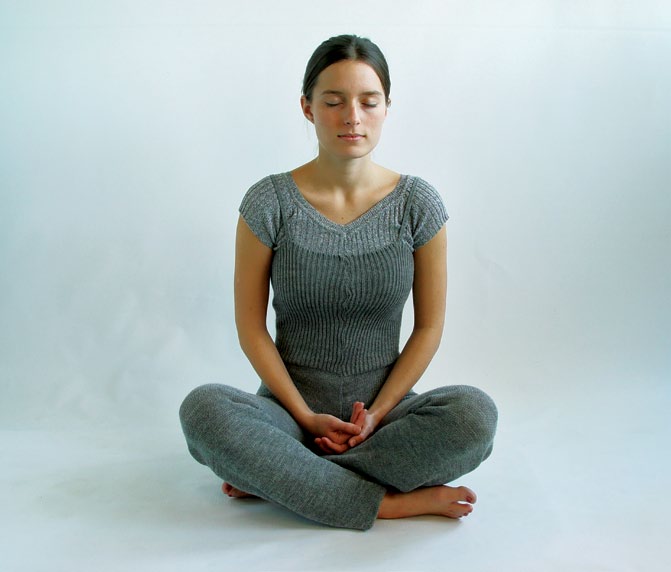
Meditative practices deepen the inward orientation of yoga.
Observing the breath
Meditation on breath
Sit comfortably with the legs crossed, or sit in a chair with good support to the lower back. Let the hands rest in the lap, palms up.
Relax the inside of the mouth: the tongue, throat, mouth and jaws.
Effortlessly let the attention follow the breath going in and out. Do not intentionally change the manner of breathing, just observe the air flowing in and out.
After 1-2 minutes, when well established in the first part of this practice (steps 1-3 above), direct the attention to the openings of the nostrils, and observe the air passing through them – in and out. At the same time, listen to the faint, almost imperceptible sound made by this flow of air.
Whenever the attention is derailed, for example by thoughts or images, effortlessly and gently return to observing the breath as described in point 4.
Continue for 5-10 minutes.
Varieties of this practice are said to have been Buddha’s preferred method of meditating. In certain contexts today, the practice is referred to as a variety of zen meditation, vipassana or mindfulness meditation.
Starting pose
Preferably, lie on the back, but sitting in a comfortable chair is an acceptable alternative.
Close the eyes.
Start
Turn the attention to the whole body to become aware of any sensations, movements, pressure, tiredness, pain, twitching, movements, etc.
Light focus – observation
Effortlessly and gently watch and follow whatever attracts the attention from moment to moment (for instance, tension in the back). Be aware of what this is and observe it.
Floating focus
When using the attention in this way, do not intentionally try to change anything. If the sensations in focus increase or diminish, or even remain unchanged or move to some other location, just observe this happening. The attention should uncritically follow whatever in the body draws it at any given moment.
Let thoughts come and go
From time to time, the attention may be diverted by thoughts, feelings, images, etc.
Whenever this happens, calmly and effortlessly return the attention to whatever it is that catches it at that moment. Body feeling is usually performed for 5-30 minutes, and it is all right to fall asleep during this time.
Body feeling is a kind of meditation on the body. Varieties of the practice frequently feature in zen meditation, vipassana and mindfulness meditation.
Body feeling
Meditation on body sensations
Acem Meditation
Meditation on sound
To get started in Acem Meditation, an introductory course with personal instruction is required. The practice cannot be learned from books. However, Acem Meditation is easy to learn and combines well both with yoga and an active, modern lifestyle.
Meditation sound and free mental attitude
Acem Meditation is practised while sitting comfortably in a chair or on a bed, in an environment which is quiet and free from external interference, sudden loud noises and strong light. The effects are reduced in crowded public places such as on a bus, train or aeroplane. The eyes should be closed. Without any effort or pressure, the student mentally repeats a meditation sound. Acem Meditation may be practised alone or in a group. The recommended duration and frequency is 30 minutes twice daily, or 45 minutes once a day.
Effects
Acem Meditation fosters relaxation, more energy for daily activities and, if practised regularly over time, personality development. The practice is a way of expanding one’s psychological and existential freedom through deep relaxation of body and mind, and by developing a greater capacity to process present and past experiences. If practised regularly, it will contribute towards a strengthening of the inner foundations of identity, yielding benefits at work and in one’s relationships to self, others and the world in general. Sporadic practice is also effective, but mostly in terms of relaxation and increased energy.
More information
Further information is available on the Internet at www.acem.com. Some references to relevant literature are given on page 160. The book Fighting Stress (Acem Publishing, 2008) summarizes scientific investigations into this form of meditation.