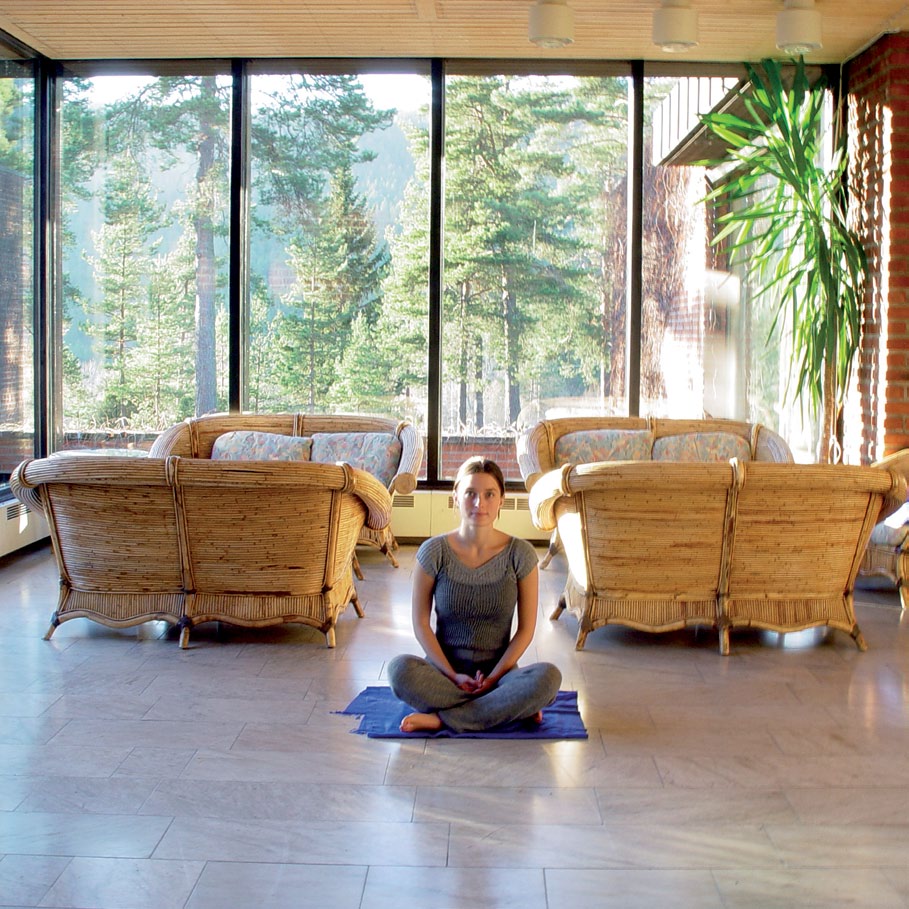
Yoga practice is based on calm attention and gradual learning.
There is no competition in yoga. The underlying principle is a free mental attitude. Each person starts from where he or she is, takes the time required and awaits progress without impatience. This section outlines the basic principles of physical yoga as taught in this book.
1. Stretch
In the yoga postures, the muscles are to be stretched gently. When the point of maximum stretch is reached, the stretch should be maintained for 30-60 seconds without causing strain or pain in the breath or body. When regularly stretched, the muscle fibres and tendons gradually respond by changing their tonus and elongating slightly.
Careful stretching is compatible with calm, unrestrained breathing and flow in the body movements. What happens in the muscles during stretching is similar to what occurs during relaxation. Stretching too far, however, will provoke pain, and the breath and the body movements will lose their gracefulness. This indicates that the person is pushing himself too far.
In sports and gymnastics, the main emphasis is on muscle contractions involving force, while in yoga the main emphasis is on stretch, but always within limits that fall short of binding the breath and movements.
2. Differentiated and coordinated movements
Done properly, yoga entails very little expenditure of energy. However, a beginner tends to use far more muscles than required, and also to struggle and strain. For example, when moving the back in unfamiliar ways, the facial muscles may be involuntarily contorted, the breath constrained, the legs or bottom tightened, and so on. With more practice, only the necessary muscles are involved. Such improvements are called differentiation and coordination; they come with practice and develop more quickly when also the attention is used - as described in paragraph 6 below.
3. Slow pace
In classical yoga, movements should be slow and should be made at a constant, unhurried pace, without force, jerking or pulling. The same goes for the transition from one posture to the next. The principle of slow movements is not applicable to the sun salutation (surya namaskar, page 96) or the impulse practices (page 107).
4. Half-open or closed eyes
When more experienced, it is advantageous to do yoga with half-open or even closed eyes. In this way, the student becomes more aware of the inner aspects of the movements, breath and mind.
5. Breathing through the nose
During the practice of yoga, it is preferable to breathe through the nose. Under times of stress or strenuous physical exercise we tend to breathe through the mouth to supply the tissues with enough oxygen. However, when we have an inner focus associated with rest, calm and meditation, we normally breathe through the nose.
6. Coordinating breath and movement
The yoga postures should be done together with deep, calm and regular breathing. The full yoga breathing (page 124) is frequently used. This manner of breathing will be audible to the student from inside of the body. The sound usually comes from the back of the nose or the throat.
The pace of the physical movements should be attuned to the rhythm of the breath. We might say that the breathing controls the movements, and the movements control the breathing. For instance, when bending forward, it is natural to breathe out. When lifting the arms, the ribs are lifted too, so it is natural to breathe in. Movements should be synchronized with the breath so that, for instance, breathing in does not start or end before the body movements start or end.
7. Use of attention
Before students of yoga have mastered a posture, most of their attention will be directed towards the physical movements. With increasing capability, the attention should be directed towards the manner of breathing whilst doing yoga. Later on, the attention is used to enter deeper into the meditative mode.
Attention to movements
With regular practice, the body will readily adapt to the yoga poses. The slow pace allows the attention to observe closely every aspect of the movements.
In this way, the student becomes aware of undifferentiated use of muscles, the tendency to use force, to move without coordinating the breath with the movements, and any binding of the breath. By focusing the attention gently, the quality of the movements gradually improves.
Breathing
As the quality of the movements improve, more attention may be given to breathing. The movements should be well coordinated with the breath and vice versa. The breath should then be observed whilst it is going in and out. In particular, the student should be aware of and avoid any tendencies towards restricting the breath. Gradually, the work on unrestrained breathing will bear fruit, and the breath will flow in and out quite freely - even in the more complicated postures.
A guiding principle is to let the free, unrestrained breathing decide how far into the postures a student goes. When trying to adopt a pose that one is not supple enough to manage fully, the muscles tend to respond by tensing as a protective measure, and the breath becomes restricted. At that moment, if the breath is made more relaxed, the body may slowly let itself move further into the pose without resistance.
The attention should be directed both from the outside and from within the body.
From the outside the student follows the movements with the eyes, observing the outermost parts of the body in motion whenever possible. For example, when lifting the right arm, the eyes may be resting on the hand as it slowly moves upwards. The gaze should not be concentrated or intense, but broad in its perspective so that the entire body is taken by a “wide angle”, and simultaneously, the student is aware of the movements in body and breath. To begin with, the eyes may be used, but with more practice the observation may be done with eyes partly or entirely closed, so that the student is watching with the “inner eye”.
From within implies awareness of how the movements are felt from inside the body: which muscles are strained, how the breath is restricted, which tendons are being pulled unnecessarily or what may feel uncomfortable.
Meditative mode
As the student gradually begins to unite breath and movement in the postures, it is time to adopt a more meditative approach, using an unfocused awareness of the entire body. The attention should be free floating and undirected, so that it encompasses all this at the same time in an unstrained manner. This meditative mode, a free mental attitude, is reinforced by keeping the eyes half-open or even completely closed at times. In this way, there is a degree of convergence between the mindset involved in performing a sequence of postures and the corpse pose (sava asana, page 114) towards the end.
8. Mobilization and relaxation
Yoga involves frequent changes between mobilization and relaxation, i.e., between moving and holding a pose, on the one hand, and relaxing after the postures, on the other. In these alternations lies an important element of training: the ability to shift and adapt swiftly between the opposing demands of using the muscles and relaxing them. The change towards relaxation is made when we lie down after postures and “let go of everything” for up to 30 seconds, before we flex our muscles again and start the next posture.
9. Ending the sequence with the corpse pose
In classical yoga, not only each individual posture, but also the whole sequence of postures is important in building up the potential for deep meditation at the end. The climax is reached in the final corpse pose. Here the mind is allowed to flow freely for some minutes; it usually goes into a spontaneous meditative dive that further vitalizes both mind and body.
Side notes
Every person progresses at his own speed, in his own way. Regular practice over time brings gradual improvements. There is no rush towards ever new goals. Only patience and persistence pay off in the long run.
When practising yoga, the attention should gently observe the movements, postures and breathing with a free mental attitude, in an undirected yet attentive manner.
In classical yoga, not one single posture but a sequence of postures is important for building up the potential for deep meditation at the end.